29 September, 2010

Renault FT-17

The Renault FT-17 was a French light tank whose development began in 1916. Its revolutionary design — featuring a fully rotating turret, a rear-mounted engine and a crew compartment at the front — laid the foundation for the basic layout of tanks that followed. The FT-17 was inexpensive, simple and well suited to mass production.

The light tank weighed 6.5 tonnes without armament or crew. Its four-cylinder petrol engine produced 39 hp and gave the vehicle a top speed of up to 8 km/h on good roads. The armor was up to 22 mm thick and the armament consisted of either a 37 mm gun or a 8mm Hotchkiss machine gun. The tank was crewed by two men.

The Renault FT-17 saw extensive service during World War I and remained in service with the armed forces of numerous countries after the war. During the Estonian War of Independence, Estonia ordered 12 light tanks from France. However, before these could be delivered, two Renaults loaned by Finland to the Northwestern Army were made available for use by the Estonians. The first tanks ordered from France arrived in Estonia only in February 1920 and therefore did not see action during the War of Independence. After the war, they were assigned to the Auto-Tank Division, which was reorganized as the Auto-Tank Regiment in 1928. The Renault light tanks remained in Estonian service until 1940, when Estonia was annexed by the Soviet Union, the Estonian armed forces were disbanded and the tanks were incorporated into the Red Army.

The model depicts a Renault light tank sporting tactical number 61, serving with the Estonian Defence Forces during the maneuvers at Otepää in 1925.

More about the model and its construction can be found at this link

Model: 1:35, RPM RPM35061 Char Mitrailleur FT-17
+ ABER-35807 FT-17 Renault - vol.1 - basic set
+
Friulmodel ATL-73 metal track for Renault FT-17
+ Tamiya 35240 German soldiers with bicycles
+ Voyager Model PE 35256 WWII German Bicycle
+ Legend LF0108 "Dear Mom" (WWII German Soldiers)
+ Legend LF0009 "German POW" (WWII)
+ Hornet HBH10, 5 heads wearing British style Officer's caps


23 August, 2010

Panzer I Ausf.A

Germany began developing the Panzer I light tank in 1932, when the Waffenamt issued a requirement for a light tank armed with machine guns. The competition was won by Krupp's prototype, which was given the codename LaS (Landwirtschaftlicher Schlepper – “agricultural tractor”). In July 1934, it entered series production as the LaS Krupp, and in 1935 it was redesignated the Panzerkampfwagen I. A total of 833 Panzer I Ausf.A vehicles were produced by June 1936.

The Panzer I Ausf.A laid the foundation for the conventional layout of German tanks of the period, with the engine located at the rear of the welded hull and the drive sprockets at the front. The crew compartment was located in the center and accommodated two crew members. The driver sat on the left, while the gunner/radio-operator/commander occupied the turret on the right. The four-cylinder Krupp boxer engine produced 57 hp and gave the 5.4-tonne vehicle a top speed of 37 km/h. The manually traversed turret was armed with two 7.92mm MG13 machine guns, with a combined rate of fire of 680 rounds per minute.

The Panzer I first saw combat during the Spanish Civil War in 1936. Until 1939, it was the main tank of the German Panzerwaffe, accounting for 46% of its tank inventory. It was used extensively during the invasions of Poland, France and Norway. The Panzer I was an inexpensive, fast and maneuverable vehicle, but its weak armor and armament meant that it was primarily suited to the infantry-support role and offered protection only against small-arms fire. When used as intended, however, it could still be a reasonably effective combat vehicle. In early 1942, the Panzer I was withdrawn from frontline service and subsequently used by police units and in anti-partisan operations.

The model depicts a Pz.Abt. z.b.V. 40, 3rd Company Panzer I Ausf.A in Norway in June 1940.

More about the model and its construction can be found at this link

Model: 1:35, Tristar 35028s Panzer I Ausf A Limited Clear Edition
+ Friulmodel ATL-20 metal track for Panzer I, Opel Maultier
+ 2x Adlers Nest
ANM-35019B MG13K barrel 'blue steel' finish
+ Legend LF0108 "Dear Mom" (WWII G
erman Soldiers)
+ THRB-05-S Scale hardware 0,5 UNM Threaded Hex Bolt

25 January, 2010

BMW R75

BMW motorcycles, like those of its rival Zündapp, were widely used by the Wehrmacht throughout the war on all fronts.

Both manufacturers began developing motorcycles with improved off-road capabilities for military use in parallel in the early 1940s. It soon became apparent that the design proposed by Zündapp had somewhat better characteristics than its BMW counterpart. However, in response to the army's ever-growing demand, motorcycle production was standardized, resulting in the BMW R75 and Zündapp KS 750, which shared up to 70% of their components.

The motorcycle was equipped with a spacious sidecar fitted with an MG34 machine gun. Its 746 cc two-cylinder boxer engine produced 26 horsepower. Two-wheel drive, including a driven sidecar wheel, low-range gears, a lockable differential, and wide tires gave the motorcycle excellent off-road capability while also providing good performance. The 670 kg vehicle could reach a top speed of up to 92 km/h.

Production of the BMW R75 continued until 1944, when the BMW factory in Eisenach was severely damaged by bombing. By that time, approximately 16,500 motorcycles had been produced. A further 98 motorcycles were assembled in 1946 as part of war reparations for the Soviet Union.

Model: 1:35 Lion Roar L3510 WWII German Motorcycle R75 with sidecar


21 May, 2009

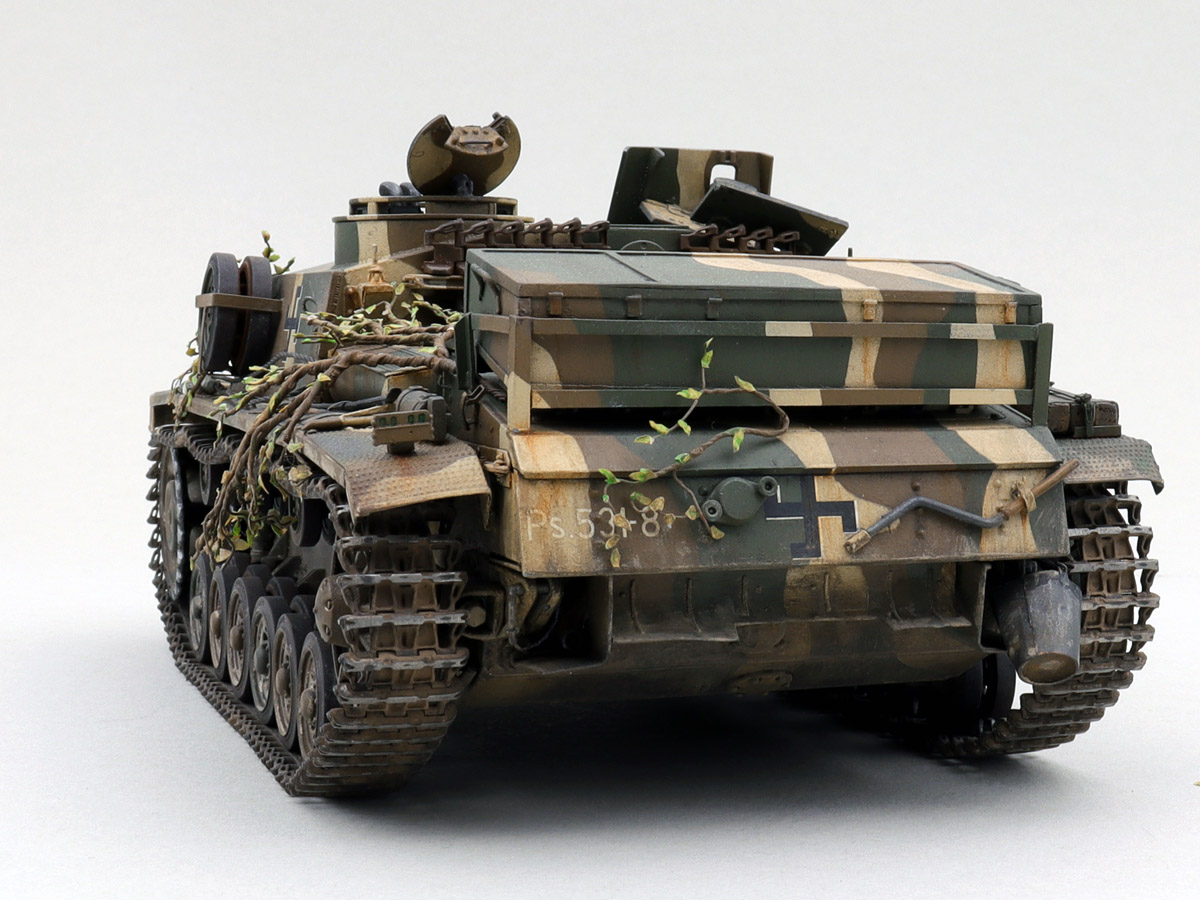
StuG III Ausf.G, Ps.531-8 "Aili"

The StuG III was an assault gun produced by Germany and built on the Panzer III chassis. Produced in various versions between 1940 and 1945, a total of 9,537 vehicles were manufactured. Initially armed with a short-barreled 75mm gun and later with a long-barreled version, it was a low-profile vehicle with considerable firepower. The main gun was mounted directly on the chassis and could traverse 12 degrees to either side. The vehicle was operated by a four-man crew consisting of a driver, gunner, loader, and commander.

The Sd.Kfz.142/1 StuG III Ausf.G, also known as the StuG 40 G, entered production in December 1942 and was the most widely produced variant of the StuG III. Its main armament was the 75 mm StuK 40 L/48 gun, supplemented by an MG34 machine gun, later replaced by a remotely operated MG42, mounted on the roof. The vehicle weighed 23.9 tonnes and was powered by a 300-hp 12-cylinder Maybach HL 120 TRM engine, giving it a top speed of up to 40 km/h.

Finland acquired a total of 59 StuG III Ausf.G-s from Germany between 1943 and 1944. The first 30 were ordered in 1943 and arrived in Finland during the summer of the same year. These were early Ausf.G vehicles with a square gun mantlet and bolted-on additional armor, and they also lacked a Zimmerit anti-magnetic coating. During the modification process, the vehicles were painted in the Finnish standard three-color hard-edged camouflage pattern. The Finnish swastika, known as “Hakaristi” was painted on both sides of the vehicle, as well as on the front and rear armor and the gun mantlet. The main modifications included replacing the MG34 machine gun with the more suitable Soviet DT, installing a large wooden equipment box on a purpose-built frame above the engine deck, relocating the spare wheels to the sides of the crew compartment, and moving the hand crank to a new position on the rear armor.

Ps 531-8 “Aili” arrived in Finland on July 6, 1943. It was manufactured by MIAG and had chassis number 95447. Its main distinguishing feature was the transmission access hatches in the front armor, which opened forward, as on the Panzer III, rather than to the sides as was normally the case on the StuG. No exceptions were made during the Finnish modifications, and as a result, its configuration remained quite similar to that of the other StuGs that arrived in Finland in 1943.

“Aili” belonged to the armored brigade of the Finnish Armored Division, where it was used as a command vehicle. Until the summer of 1944, when active hostilities with the Soviet Union resumed, it took part in various exercises, training maneuvers, and drills. The Sturmi, as the vehicles were known in Finland, saw active frontline service for only three weeks. During this period, “Aili” was credited with a total of seven Soviet T-34 tank kills: five on June 25 near Leitimojärvi during the Battle of Tali-Ihantala, and two on July 11 during the Battle of Vuosalmi. After the armistice with the Soviet Union, attempts were made to use the vehicles against the Germans during the Lapland War, but they did not take part in combat. Today, “Aili” is preserved in restored condition at the Reserviupseerikoulu Museum in Hamina.

The model can be placed in the final days of June 1944, during the battle of Tali-Ihantala.

More information about this model can be found here

(Information on the Finnish StuGs was sourced from Andreas Lärka's website www.andreaslarka.net)

Model: 1:35 Dragon 6320 StuG.III Ausf.G early production
+ Voyager Model PE 35109 fenders for StuG III Ausf G
+ Friulmodel ATL-05 metal track for Panzer III/IV


10 January, 2009

Fieseler Fi 156 A-0/C-1 Storch

The Fieseler Fi 156 Storch was a small reconnaissance aircraft developed by Fieseler and produced in Germany before and during World War II, as well as under license in several other countries after the war. The aircraft is particularly notable for its ability to take off and land over extremely short distances, which is why the Fi 156 and its foreign-built variants remain popular attractions at air shows to this day.

The Reichsluftfahrtministerium issued a requirement for a new Luftwaffe aircraft as early as 1935. The aircraft was intended for reconnaissance, maintaining communications with frontline units, and providing rapid medical assistance and evacuation in conditions where conventional aircraft operations were difficult. The design proposed by Reinhold Mews and Erich Bachem was approved primarily because of the aircraft's exceptionally short takeoff and landing distances. The wings could be folded backward, allowing the aircraft to be transported on a trailer or, in some cases, even towed directly behind a truck. The long-travel landing gear, with 450 mm of suspension travel, allowed the aircraft to operate from almost any type of terrain.

The prototype made its first flight in the spring of 1936, and the first A-0 production aircraft entered Luftwaffe service in mid-1937. The aircraft was powered by a 240-hp inverted V-8 engine, giving it a maximum speed of 175 km/h while allowing it to fly at speeds as low as 50 km/h. This low-speed capability made the aircraft well suited for aerial reconnaissance in support of ground forces, while its landing distance could be as short as 18 meters. With a light headwind, it required a runway of only 45 meters for takeoff. These characteristics allowed the aircraft to operate from almost any forest clearing.

Later versions were fitted with an MG15 machine gun for self-defense. Skis were also sometimes fitted in place of the wheels, allowing the aircraft to operate in snowy terrain.

The Fieseler Fi 156 was used on almost every front during World War II. One of its most notable operations was the rescue of Benito Mussolini in 1943, when Mussolini and Otto Skorzeny were flown out aboard a Fieseler Storch. After the war, the aircraft saw service with the air forces of numerous countries, including Bulgaria, Czechoslovakia, Finland, Sweden, France, Italy, Norway, Poland, the United Kingdom, the Soviet Union, Spain, and Laos. The aircraft was also produced under license in several countries. 

More information about this model can be found here

Model: 1:35 Tristar 35034 Fieseler Fi156 A-0/C-1

28 August, 2008

LWS Land-Wasser-Schlepper (mid production)

The LWS (Land-Wasser-Schlepper) was an unarmored German military transport vehicle operated by the Kriegsmarine and engineering troops. It was designed for crossing water obstacles and landing troops on shore. Development of the vehicle began as early as 1935, but the assembly of the first series-production LWS vehicles did not begin at the Rheinmetall-Borsig factory until 1940. The first series consisted of seven vehicles, which subsequently underwent extensive testing.

The first-series amphibious vehicles had a relatively spacious crew compartment with large windows, which could be closed with armored covers if necessary, as well as small portholes. Air was supplied to the crew compartment and engine through three shafts that extended above the roof of the crew compartment. The propellers and towing hook were located at the rear of the amphibious vehicle. The drive sprocket was located at the front, and the vehicle was powered by a Maybach HL 108 TRM, the same engine that was used in the Panzer IV. It could reach a speed of 35 km/h on land and 12 km/h in water.

After several improvements, the second series entered production in early 1941, and by March a total of 14 vehicles had been produced. The crew compartment was extensively redesigned: the size of the windows was reduced, the number of portholes was reduced to three per side, the position of the towing hook was changed, and a number of other minor modifications were introduced. Instead of three air shafts, there was now a single larger shaft equipped with forced ventilation. In place of the two smaller shafts previously located at the rear, there was now an open bridge.

These vehicles operated in North Africa, Western Europe, and on the Eastern Front. The amphibious vehicles probably saw little, if any, direct combat, but were used to supply advancing troops, carry out diversionary operations, and cross larger bodies of water. The last records of LWS vehicles date from 1944, when the remaining vehicles were used to supply isolated formations in the Baltic region, East Prussia, and Belgium. One of the amphibious vehicles, numbered “234,” was also captured by the British in North Africa.

LWS-667 was one of the 14 vehicles produced as part of the second series. It initially belonged to the Pionier-Bataillon 627 (mot.) and served on the Eastern Front. At the end of 1941 or early 1942, the vehicle was transferred to the newly formed Pionier-LandungsKp. 778, repainted with the markings shown on the model, and sent to North Africa, where it took part in operations in the Tobruk area. The vehicle was destroyed during the capture of Tobruk on November 11 or 12, 1942.

More information about this model can be found here

Model: 1:35 Bronco CB-35015 Land-Wasser-Schlepper (middle production)
+ 1:35 Dragon 6193 German halftrack crewmen