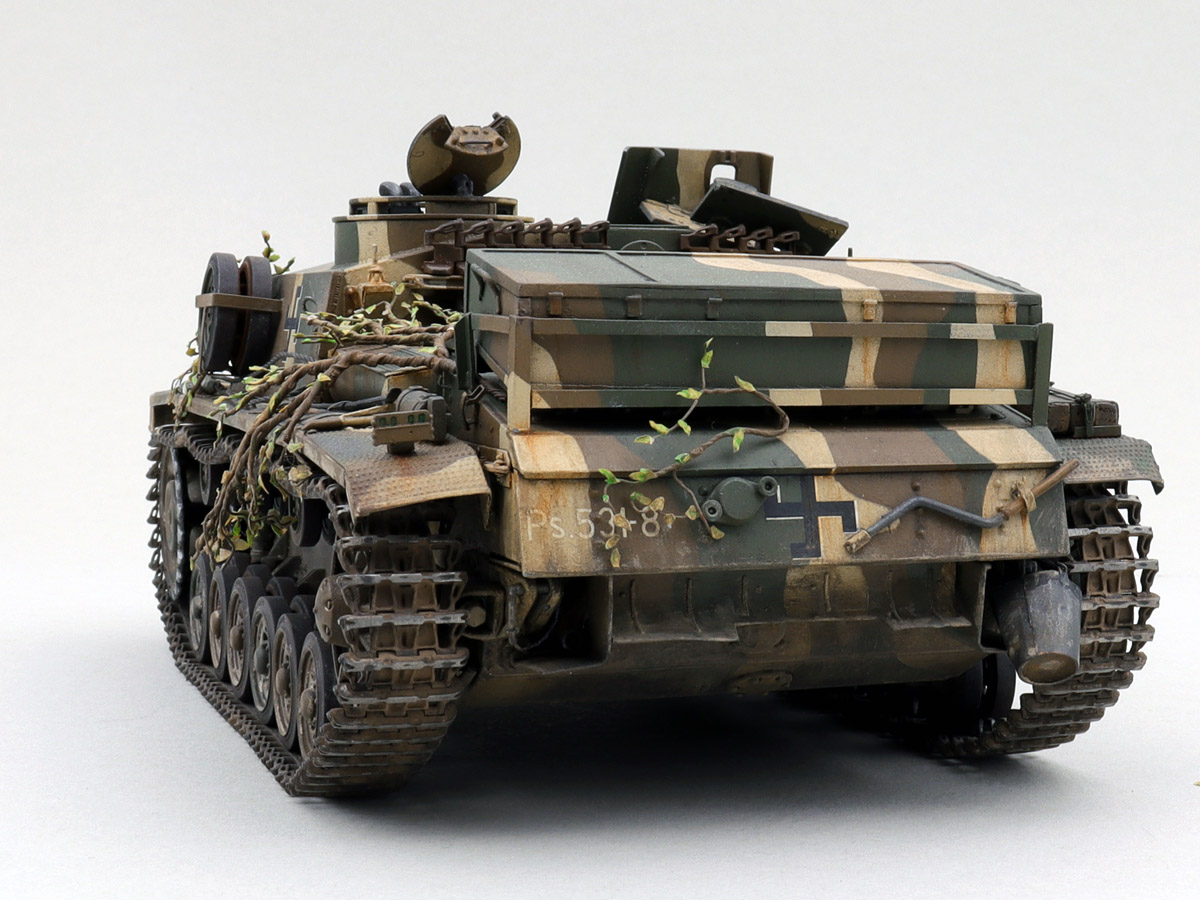
The StuG III was an assault gun produced by Germany and built on the Panzer III chassis. Produced in various versions between 1940 and 1945, a total of 9,537 vehicles were manufactured. Initially armed with a short-barreled 75mm gun and later with a long-barreled version, it was a low-profile vehicle with considerable firepower. The main gun was mounted directly on the chassis and could traverse 12 degrees to either side. The vehicle was operated by a four-man crew consisting of a driver, gunner, loader, and commander.
The Sd.Kfz.142/1 StuG III Ausf.G, also known as the StuG 40 G, entered production in December 1942 and was the most widely produced variant of the StuG III. Its main armament was the 75 mm StuK 40 L/48 gun, supplemented by an MG34 machine gun, later replaced by a remotely operated MG42, mounted on the roof. The vehicle weighed 23.9 tonnes and was powered by a 300-hp 12-cylinder Maybach HL 120 TRM engine, giving it a top speed of up to 40 km/h.
Finland acquired a total of 59 StuG III Ausf.G-s from Germany between 1943 and 1944. The first 30 were ordered in 1943 and arrived in Finland during the summer of the same year. These were early Ausf.G vehicles with a square gun mantlet and bolted-on additional armor, and they also lacked a Zimmerit anti-magnetic coating. During the modification process, the vehicles were painted in the Finnish standard three-color hard-edged camouflage pattern. The Finnish swastika, known as “Hakaristi” was painted on both sides of the vehicle, as well as on the front and rear armor and the gun mantlet. The main modifications included replacing the MG34 machine gun with the more suitable Soviet DT, installing a large wooden equipment box on a purpose-built frame above the engine deck, relocating the spare wheels to the sides of the crew compartment, and moving the hand crank to a new position on the rear armor.
Ps 531-8 “Aili” arrived in Finland on July 6, 1943. It was manufactured by MIAG and had chassis number 95447. Its main distinguishing feature was the transmission access hatches in the front armor, which opened forward, as on the Panzer III, rather than to the sides as was normally the case on the StuG. No exceptions were made during the Finnish modifications, and as a result, its configuration remained quite similar to that of the other StuGs that arrived in Finland in 1943.
“Aili” belonged to the armored brigade of the Finnish Armored Division, where it was used as a command vehicle. Until the summer of 1944, when active hostilities with the Soviet Union resumed, it took part in various exercises, training maneuvers, and drills. The Sturmi, as the vehicles were known in Finland, saw active frontline service for only three weeks. During this period, “Aili” was credited with a total of seven Soviet T-34 tank kills: five on June 25 near Leitimojärvi during the Battle of Tali-Ihantala, and two on July 11 during the Battle of Vuosalmi. After the armistice with the Soviet Union, attempts were made to use the vehicles against the Germans during the Lapland War, but they did not take part in combat. Today, “Aili” is preserved in restored condition at the Reserviupseerikoulu Museum in Hamina.
The model can be placed in the final days of June 1944, during the battle of Tali-Ihantala.
(Information on the Finnish StuGs was sourced from Andreas Lärka's website www.andreaslarka.net)
Model: 1:35 Dragon 6320 StuG.III Ausf.G early production
+ Voyager Model PE 35109 fenders for StuG III Ausf G
+ Friulmodel ATL-05 metal track for Panzer III/IV