28 August, 2008

LWS Land-Wasser-Schlepper (mid production)

The LWS (Land-Wasser-Schlepper) was an unarmored German military transport vehicle operated by the Kriegsmarine and engineering troops. It was designed for crossing water obstacles and landing troops on shore. Development of the vehicle began as early as 1935, but the assembly of the first series-production LWS vehicles did not begin at the Rheinmetall-Borsig factory until 1940. The first series consisted of seven vehicles, which subsequently underwent extensive testing.

The first-series amphibious vehicles had a relatively spacious crew compartment with large windows, which could be closed with armored covers if necessary, as well as small portholes. Air was supplied to the crew compartment and engine through three shafts that extended above the roof of the crew compartment. The propellers and towing hook were located at the rear of the amphibious vehicle. The drive sprocket was located at the front, and the vehicle was powered by a Maybach HL 108 TRM, the same engine that was used in the Panzer IV. It could reach a speed of 35 km/h on land and 12 km/h in water.

After several improvements, the second series entered production in early 1941, and by March a total of 14 vehicles had been produced. The crew compartment was extensively redesigned: the size of the windows was reduced, the number of portholes was reduced to three per side, the position of the towing hook was changed, and a number of other minor modifications were introduced. Instead of three air shafts, there was now a single larger shaft equipped with forced ventilation. In place of the two smaller shafts previously located at the rear, there was now an open bridge.

These vehicles operated in North Africa, Western Europe, and on the Eastern Front. The amphibious vehicles probably saw little, if any, direct combat, but were used to supply advancing troops, carry out diversionary operations, and cross larger bodies of water. The last records of LWS vehicles date from 1944, when the remaining vehicles were used to supply isolated formations in the Baltic region, East Prussia, and Belgium. One of the amphibious vehicles, numbered “234,” was also captured by the British in North Africa.

LWS-667 was one of the 14 vehicles produced as part of the second series. It initially belonged to the Pionier-Bataillon 627 (mot.) and served on the Eastern Front. At the end of 1941 or early 1942, the vehicle was transferred to the newly formed Pionier-LandungsKp. 778, repainted with the markings shown on the model, and sent to North Africa, where it took part in operations in the Tobruk area. The vehicle was destroyed during the capture of Tobruk on November 11 or 12, 1942.

More information about this model can be found here

Model: 1:35 Bronco CB-35015 Land-Wasser-Schlepper (middle production)
+ 1:35 Dragon 6193 German halftrack crewmen


21 August, 2008

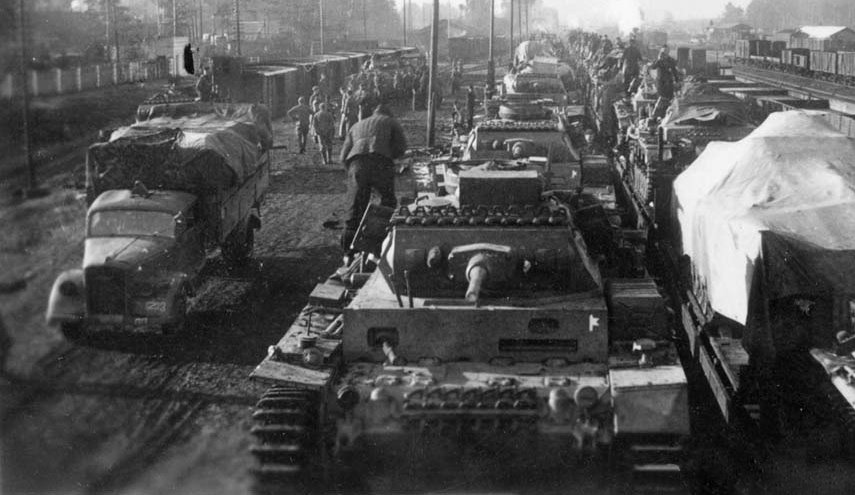
Panzer III Ausf.J

The Panzer III was a medium tank produced in Germany between 1937 and 1943. Its development began in 1934, at the same time as the Panzer IV, and it became one of Germany's most widely used tanks during World War II. In 1935, MAN, Daimler-Benz AG, Rheinmetall-Borsig, and Krupp AG were invited to compete for a contract to design a medium tank with a target weight of 15 tonnes and a top speed of at least 40 km/h. A 37 mm gun was selected as the main armament, but the turret was designed to accommodate a larger-caliber weapon if required, which was later done.

The Panzer III was the first German tank to be equipped with an intercom system. It was also the first German tank to use torsion-bar suspension. The hull consisted of four main modules: the turret, lower hull, front upper hull section with the turret ring, and rear upper hull section with the engine access hatches. All these were of welded construction and then bolted together. Mass production of the Ausf.F version began in 1939. Between 1937 and 1940, attempts were made to standardize components between Krupp's Panzer IV and Daimler-Benz's Panzer III.

Production of the Panzer III Ausf.J began in March 1941. Compared with earlier versions, the thickness of the armor was significantly increased. The driver received a new type of vision port, the Fahrersehklappe 50, while the hull-mounted machine gun was fitted with a new type of ball mount, the Kugelblende 50. The transmission access hatches were redesigned as single-piece covers, and the front air intake openings were also redesigned. From December 1941, the Ausf. J began to be fitted with the longer 50 mm KwK 39 L/60 gun, and its designation was changed from Sd.Kfz. 141 to Sd.Kfz. 141/1. The Ausf.J was produced until July 1942, with 1,549 short-barreled and 1,067 long-barreled vehicles manufactured.

The Panzer III was powered by a 12-cylinder, 265-hp Maybach HL 120 TRM engine, which gave the 21.5-tonne armored vehicle a top speed of up to 40 km/h. In addition to its main armament, the tank was equipped with two 7.92 mm MG34 machine guns and was operated by a crew of five.

More information about this model can be found here

Mudel: 1:35 Dragon 
6494 Pz.Kpfw.III Ausf.J 2in1
+ Dragon 6375 German Tank Crew 1939-1943


20 August, 2008

Jagdpanzer IV ausf. A-0

The Jagdpanzer IV was a German tank destroyer based on the Panzer IV chassis and developed as a replacement for the StuG III.

In December 1942, the Waffenamt commissioned a new tank destroyer concept. Based on the Panzer IV chassis, it was to have 100  mm of frontal armor and use the 75 mm Pak 42 L/70 gun as its main armament—the same gun fitted to the Panther tank. The vehicle was to have a low silhouette, with the main gun mounted directly in the hull. Design work began in early 1943, and in December of the same year, VoMAG was ordered to begin series production of the Jagdpanzer IV.

The first 0-series vehicles were built on the Panzer IV Ausf.F chassis. They differed from later ones in having rounded corners on the frontal armor and were equipped with two MG42 machine guns instead of one. The 0-series vehicles were used primarily as test vehicles, on which various technical solutions were evaluated. As a result, the individual 0-series vehicles differed from one another in various details. They were also used as training vehicles for tank crews. Toward the end of the war, some of the 0-series Jagdpanzer IV's saw combat after being assigned to the Lehr Division.

Model: 1:35 Dragon 9059 Jagdpanzer IV A-0


Flakpanzer I ausf.A

The Flakpanzer I Ausf.A was a self-propelled anti-aircraft gun based on the Panzer I chassis and armed with a 2 cm Flak 38 L/112.5 anti-aircraft gun.

The Flakpanzer I was developed during the Battle of France, when it became apparent that anti-aircraft guns mounted on half-tracks were insufficiently armoured. It was decided to combine light anti-aircraft guns with tank chassis and the chassis of the Panzer I was chosen for these conversions simply because it was readily available. The conversions were carried out by Stoewer.

Only 24 Panzer I Ausf.A vehicles were converted into anti-aircraft tanks, apparently using the Munitionsschlepper I Ausf.A as the basis. The conversions were carried out in early 1941, making them Germany's first series-produced anti-aircraft tanks.

Model: 1:35 Tristar 35
019 German Flak Panzer IA w/. Ammo Trailer

Sd.Kfz.2 Kettenkrad

The Kleines Kettenkraftrad, commonly known as the Kettenkrad, was developed as a light tractor for airborne units. It was the only half-track vehicle small enough to fit inside the cargo compartment of a Junkers Ju 52. The Kettenkrad was developed by NSU Motorenwerke AG in 1939 and entered production at the end of 1940.

Despite its original purpose, the Kettenkrad quickly became popular and was used primarily on the Eastern Front to tow light artillery pieces, anti-aircraft guns, mortars, field cable reels, and various types of trailers, as well as to transport personnel. The vehicle's success was largely due to its excellent cross-country mobility and ability to negotiate difficult terrain. On sand, it could climb slopes of up to 24 degrees, while on hard ground, its climbing ability was limited mainly by the driver's courage.

The Kettenkrad was powered by a 4-cylinder, 1.5-liter, water-cooled engine designed by Opel, which produced 36 hp. Steering was achieved through a combination of the front wheel and clutches on the drive sprockets, giving the vehicle relatively good maneuverability. The Sd.Kfz. 2 weighed 1,560 kg and could reach a maximum speed of 70 km/h.

A total of 8,345 vehicles were produced before production was discontinued in 1944. After the war, the Kettenkrad continued to be manufactured for agricultural use until 1949.

Model: 1:35 Tamiya 35029 Sd.kfz.2 Kleines Kettenkraftrad


2cm Flakvierling 38

The Flakvierling 38 was an anti-aircraft gun that was significantly more effective than the standard 2 cm Flak 38 in terms of rate and density of fire. The Flakvierling was used on a triangular mount and was also mounted on several vehicles.

The Flakvierling was essentially four Flak 38 guns combined and synchronized to fire together. The mount was fitted with folding seats for the loaders and provided basic light armor protection. It was made wider and, like the standard Flak 38, the weapon could be quickly loaded onto a specially designed trailer for transport. Each barrel was fed from a 20-round magazine, and the four barrels fired in diagonal pairs at a rate of up to 1,800 rounds per minute. Its effective vertical range reached 2,200 meters, and it could be used both for anti-aircraft defense and against ground targets.

The Flakvierling was transported on an Sd.Ah. 52 trailer, which could be towed by various vehicles. In emergencies, it was possible to open fire directly from the trailer while the gun was still in its travel configuration. The Flakvierling was manufactured by Mauser between 1940 and 1945. It weighed 1,509 kg and was operated by a crew of eight.

Model: 1:35 Tamiya 35091 20mm Flakvierling 38

Tiger II

The Tiger II Ausf.B Königstiger was the most powerful battle tank of World War II, for which the Allies had no effective countermeasure in their arsenal until the end of the war. The M4 Sherman was unable to penetrate its main armor even at very close range, while the M26 Pershing or IS-2 had to fire from a distance of less than 1,300 meters to achieve a successful hit.

The design of the Tiger II began in May 1941, and serious work on a new tank intended to replace the Tiger I began toward the end of 1942. By Hitler's order, the new Tiger was to be armed with an 88 mm gun, with 150 mm of frontal armor and 80 mm of side armor. Following the example of the Panther, the armor was to be sloped and attached using so-called interlocking joints. The contract to develop the tank was awarded to Henschel and Porsche. Of the two designs, Henschel's version was selected for series production because it was more compatible with existing German tank-design principles, shared many components with the Panther, and was simpler to build.

Production of the Tiger II began in January 1944, and until September 1944 all Tiger IIs were coated with Zimmerit (an anti-magnetic paste intended to prevent the attachment of magnetic mines). The first 50 tanks were fitted with turrets manufactured by Krupp for Porsche, and these are commonly known as Porsche-turret Tigers.

The Tiger II with the Henschel turret weighed 69.8 tonnes. It was powered by a 12-cylinder Maybach HL 230 P30 engine producing 700 hp, which gave the tank a maximum speed of 41.5 km/h. Its main armament was the 88 mm KwK 43 L/71 gun, supplemented by two 7.92 mm MG34/42 machine guns. The hull's frontal armor was 150 mm thick and sloped at 50°, while the turret front was 180 mm thick at 9°. The hull side armor was 80 mm thick at 25°, and the turret side armor was 80 mm thick at 21°.

By the end of the war, a total of 487 Tiger II tanks had been produced.

Model: 1:35 Dragon 6208 Sd.Kfz.182 King Tiger