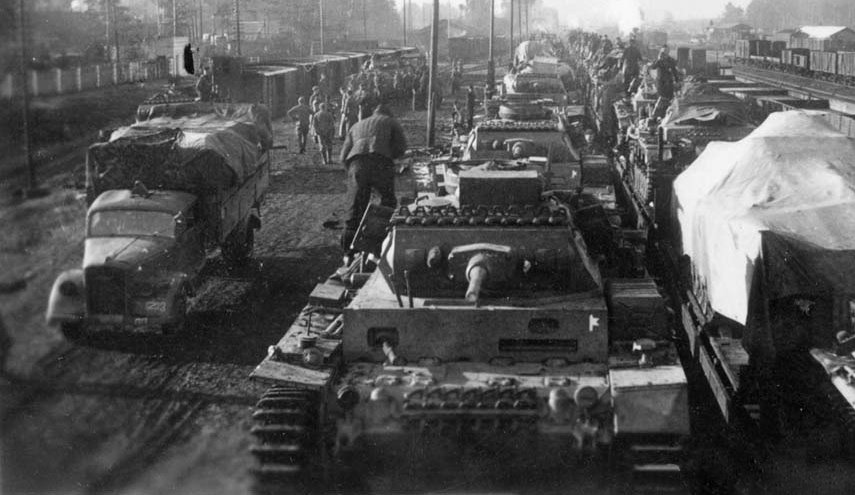
The Panzer III was a medium tank produced in Germany between 1937 and 1943. Its development began in 1934, at the same time as the Panzer IV, and it became one of Germany's most widely used tanks during World War II. In 1935, MAN, Daimler-Benz AG, Rheinmetall-Borsig, and Krupp AG were invited to compete for a contract to design a medium tank with a target weight of 15 tonnes and a top speed of at least 40 km/h. A 37 mm gun was selected as the main armament, but the turret was designed to accommodate a larger-caliber weapon if required, which was later done.
The Panzer III was the first German tank to be equipped with an intercom system. It was also the first German tank to use torsion-bar suspension. The hull consisted of four main modules: the turret, lower hull, front upper hull section with the turret ring, and rear upper hull section with the engine access hatches. All these were of welded construction and then bolted together. Mass production of the Ausf.F version began in 1939. Between 1937 and 1940, attempts were made to standardize components between Krupp's Panzer IV and Daimler-Benz's Panzer III.
Production of the Panzer III Ausf.J began in March 1941. Compared with earlier versions, the thickness of the armor was significantly increased. The driver received a new type of vision port, the Fahrersehklappe 50, while the hull-mounted machine gun was fitted with a new type of ball mount, the Kugelblende 50. The transmission access hatches were redesigned as single-piece covers, and the front air intake openings were also redesigned. From December 1941, the Ausf. J began to be fitted with the longer 50 mm KwK 39 L/60 gun, and its designation was changed from Sd.Kfz. 141 to Sd.Kfz. 141/1. The Ausf.J was produced until July 1942, with 1,549 short-barreled and 1,067 long-barreled vehicles manufactured.
The Panzer III was powered by a 12-cylinder, 265-hp Maybach HL 120 TRM engine, which gave the 21.5-tonne armored vehicle a top speed of up to 40 km/h. In addition to its main armament, the tank was equipped with two 7.92 mm MG34 machine guns and was operated by a crew of five.


No comments:
Post a Comment