The tactics of blitzkrieg and the need to quickly overcome both natural and man-made obstacles created a requirement in Germany for a heavy-duty mobile bridge-layer with a high load capacity. Following small-scale trials, the Magirus and Krupp factories converted 20 Panzer IV Ausf.C and Ausf.D tanks into bridge-layers in early 1940, with Magirus producing four vehicles and Krupp the remaining 16. The lifting mechanisms and bridges developed by the two manufacturers differed considerably.
In the case of the Krupp vehicles, the turret was removed and the resulting opening was covered with a wooden plate. Two parallel rails were mounted on the roof to support the bridge. The forward sections of the rails were designed as reinforced frames that could be raised and lowered, with the bridge's lifting frame attached to them by massive hinges. The bridge itself consisted of two parallel longitudinal box girders, with a deployable support leg attached underneath. The top of the bridge was covered with thick wooden planks. The bridge was deployed using cable mechanisms operated by electric motors.
The bridge had a load capacity of 28 tonnes, which was sufficient to carry all contemporary German tanks and armored vehicles. At the same time, the massive structure made the bridge-layer itself relatively heavy, weighing approximately 28 tonnes as well. By comparison, the Panzer IV weighed around 22 tonnes at the time. The additional weight placed considerable strain on the suspension and drivetrain and also hindered the vehicle's operation on softer riverbanks. The lifting mechanism was apparently also too complex and by the end of 1940 the remaining Panzer IV-based bridge-layer vehicles were converted back into conventional tanks. Nevertheless, they saw extensive use during the campaigns in Belgium and France in the spring and summer of 1940.
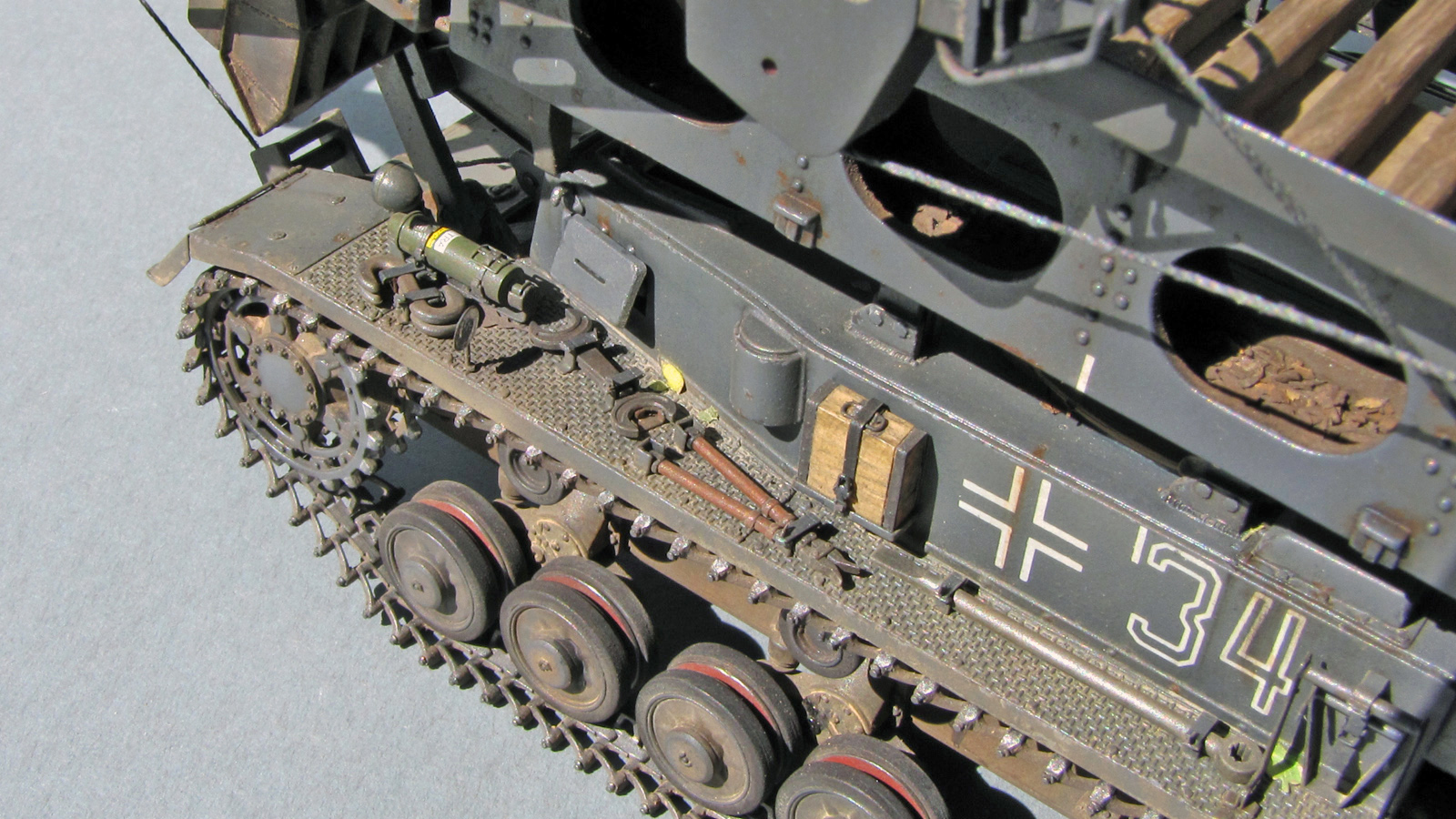
None of these vehicles have survived to the present day. No original factory drawings have survived either, so detailed technical information about them is limited. Consequently, this model was built using two different kits: Dragon's Panzer IV Ausf.D and Trumpeter's Brückenleger IVB, which is currently the only such kit available on the market. As the Trumpeter bridge-layer is not particularly accurate, the bridge support mechanism was scratch-built using available photographic references. The model depicts bridge-layer with tactical number 34 during the campaign in France in May 1940.




1 comment:
Vaimustav; vaimustav - eriti meeldib mulle konstruktsiooni karpides olevad rooste liistakud. Ja köied ja nende ajamid.
Rohkem, kui ehtne!!
Post a Comment