09 March, 2012

Schwimmwagen VW typ.166

More about the model and its construction can be found at this link

Model: 1:35 Tamiya 35224, Schwimmwagen type 166
+ Voyager Model PE 35224, WWII German Schwimmwagen
+ Hussar 35073, Schwimmwagen wheels
+ Tamiya 35240, WWII German soldier with bicycles
+ Voyager Model PE 35256, WWII German bicycle
+ Orange Hobby G35-005, German M24 Stielhandgranate
+ Alpine Miniatures 35042, SS panzer recon officer
+ Archer AR35313 Scwimmwagen, Kübelwagen and Kettenkrad Instruments and Plackards


18 May, 2011

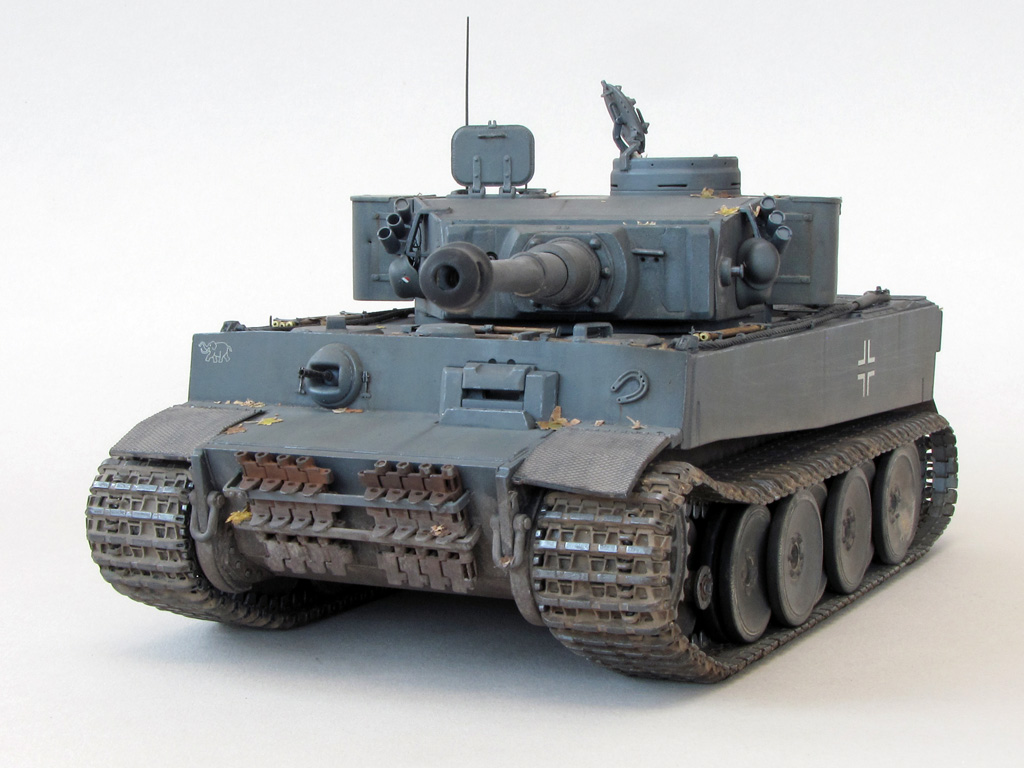
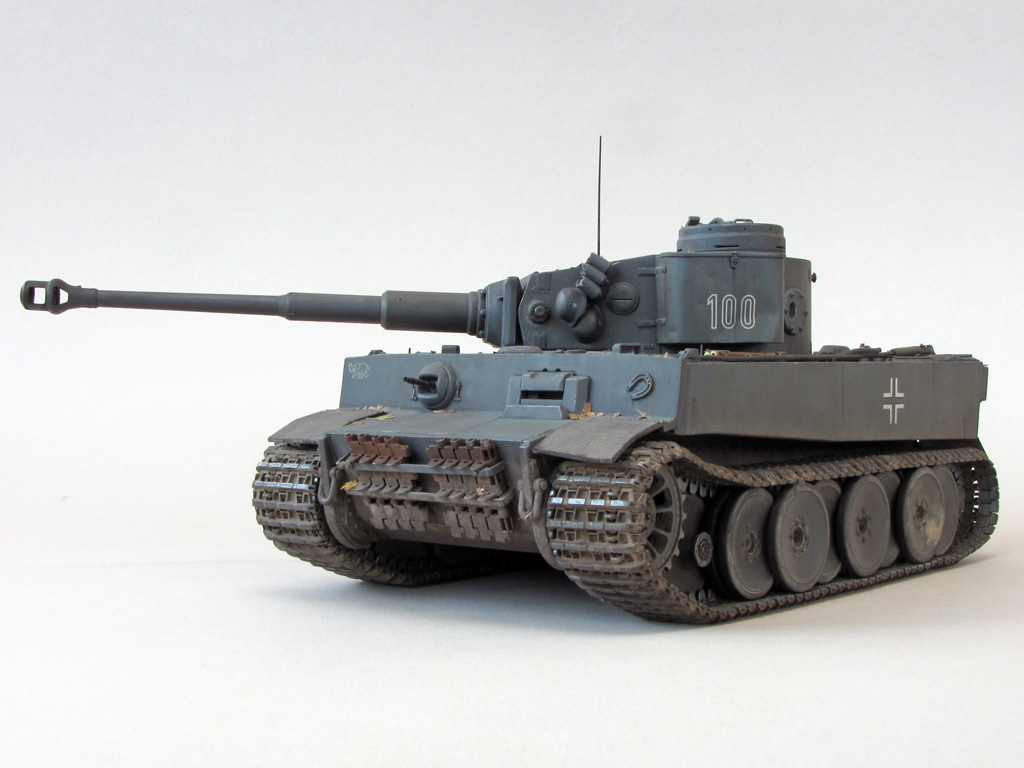
Tiger I (Initial production)

The Tiger I was a German heavy tank produced during World War II. Its powerful main armament and thick armor earned it a reputation as one of the most feared tanks on both the Eastern and Western Fronts.

Development of the tank had begun as early as 1937, but it gained significant momentum in mid-1941 following the invasion of the Soviet Union. Series production began in August 1942 and continued until August 1944, when production was discontinued in favor of the Tiger II. The Tiger I was technically complex — its production took roughly twice as long and required considerably more resources than that of other German tanks of the period. A total of 1,355 vehicles were produced.

The model depicts one of the earliest Tigers produced. Tank number 100 was completed in early August 1942. It lacked the standard stowage bin mounted on the rear of the turret, instead featuring distinctive stowage bins bolted on the sides of the turret. The tank was sent to the Leningrad Front for combat trials in late August 1942 and was eventually captured intact by Soviet forces in January 1943. The model can be placed in the September–October 1942 timeframe.

More about the model and its construction can be found at this link

Model: 1:35 Dragon 6600 Tiger I Initial 
+ Aber 35177, Sd.Kfz 181, Pz.Kpfw.VI Ausf.E Tiger I initial 
+ Aber 35A106 Turret side stowage bins for Tiger I initial
+ Aber R26 German 2m aerials
+ MasterClub MC135007W Tiger I Initial type tracks 
+ RB Models 35B01 8,8cm KwK 36 L/56 Tiger I (early model) 
+ RB Models 35B38 7,92 MG34 Tank version of MG34 
+ LionMarc Model Designs LM10029 7,92 MG34 barrel tank variant


29 September, 2010

Renault FT-17

The Renault FT-17 was a French light tank whose development began in 1916. Its revolutionary design — featuring a fully rotating turret, a rear-mounted engine and a crew compartment at the front — laid the foundation for the basic layout of tanks that followed. The FT-17 was inexpensive, simple and well suited to mass production.

The light tank weighed 6.5 tonnes without armament or crew. Its four-cylinder petrol engine produced 39 hp and gave the vehicle a top speed of up to 8 km/h on good roads. The armor was up to 22 mm thick and the armament consisted of either a 37 mm gun or a 8mm Hotchkiss machine gun. The tank was crewed by two men.

The Renault FT-17 saw extensive service during World War I and remained in service with the armed forces of numerous countries after the war. During the Estonian War of Independence, Estonia ordered 12 light tanks from France. However, before these could be delivered, two Renaults loaned by Finland to the Northwestern Army were made available for use by the Estonians. The first tanks ordered from France arrived in Estonia only in February 1920 and therefore did not see action during the War of Independence. After the war, they were assigned to the Auto-Tank Division, which was reorganized as the Auto-Tank Regiment in 1928. The Renault light tanks remained in Estonian service until 1940, when Estonia was annexed by the Soviet Union, the Estonian armed forces were disbanded and the tanks were incorporated into the Red Army.

The model depicts a Renault light tank sporting tactical number 61, serving with the Estonian Defence Forces during the maneuvers at Otepää in 1925.

More about the model and its construction can be found at this link

Model: 1:35, RPM RPM35061 Char Mitrailleur FT-17
+ ABER-35807 FT-17 Renault - vol.1 - basic set
+
Friulmodel ATL-73 metal track for Renault FT-17
+ Tamiya 35240 German soldiers with bicycles
+ Voyager Model PE 35256 WWII German Bicycle
+ Legend LF0108 "Dear Mom" (WWII German Soldiers)
+ Legend LF0009 "German POW" (WWII)
+ Hornet HBH10, 5 heads wearing British style Officer's caps


23 August, 2010

Panzer I Ausf.A

Germany began developing the Panzer I light tank in 1932, when the Waffenamt issued a requirement for a light tank armed with machine guns. The competition was won by Krupp's prototype, which was given the codename LaS (Landwirtschaftlicher Schlepper – “agricultural tractor”). In July 1934, it entered series production as the LaS Krupp, and in 1935 it was redesignated the Panzerkampfwagen I. A total of 833 Panzer I Ausf.A vehicles were produced by June 1936.

The Panzer I Ausf.A laid the foundation for the conventional layout of German tanks of the period, with the engine located at the rear of the welded hull and the drive sprockets at the front. The crew compartment was located in the center and accommodated two crew members. The driver sat on the left, while the gunner/radio-operator/commander occupied the turret on the right. The four-cylinder Krupp boxer engine produced 57 hp and gave the 5.4-tonne vehicle a top speed of 37 km/h. The manually traversed turret was armed with two 7.92mm MG13 machine guns, with a combined rate of fire of 680 rounds per minute.

The Panzer I first saw combat during the Spanish Civil War in 1936. Until 1939, it was the main tank of the German Panzerwaffe, accounting for 46% of its tank inventory. It was used extensively during the invasions of Poland, France and Norway. The Panzer I was an inexpensive, fast and maneuverable vehicle, but its weak armor and armament meant that it was primarily suited to the infantry-support role and offered protection only against small-arms fire. When used as intended, however, it could still be a reasonably effective combat vehicle. In early 1942, the Panzer I was withdrawn from frontline service and subsequently used by police units and in anti-partisan operations.

The model depicts a Pz.Abt. z.b.V. 40, 3rd Company Panzer I Ausf.A in Norway in June 1940.

More about the model and its construction can be found at this link

Model: 1:35, Tristar 35028s Panzer I Ausf A Limited Clear Edition
+ Friulmodel ATL-20 metal track for Panzer I, Opel Maultier
+ 2x Adlers Nest
ANM-35019B MG13K barrel 'blue steel' finish
+ Legend LF0108 "Dear Mom" (WWII G
erman Soldiers)
+ THRB-05-S Scale hardware 0,5 UNM Threaded Hex Bolt