The TKS was a light turretless tracked reconnaissance vehicle. Developed in Poland in the early 1930s, the TK family of tankettes was based largely on the chassis of the British Carden-Loyd Mk VI. The TKS was an improved version of the TK series. Its development began in 1933, followed by production in 1934.
The armoured hull was riveted together from steel plates 4–10 mm thick. The two-man crew consisted of a driver and a commander, who sat on either side of the six-cylinder Polski Fiat 122BC petrol engine. This 2,952 cm³ engine produced 46 hp and gave the 2,570 kg tankette a top speed of 40 km/h on good roads. The tankette was armed with a single air-cooled 7.92 mm ckm wz.25 machine gun, essentially a Czech variant of the Hotchkiss M1914. It was also fitted with a periscope for the commander.
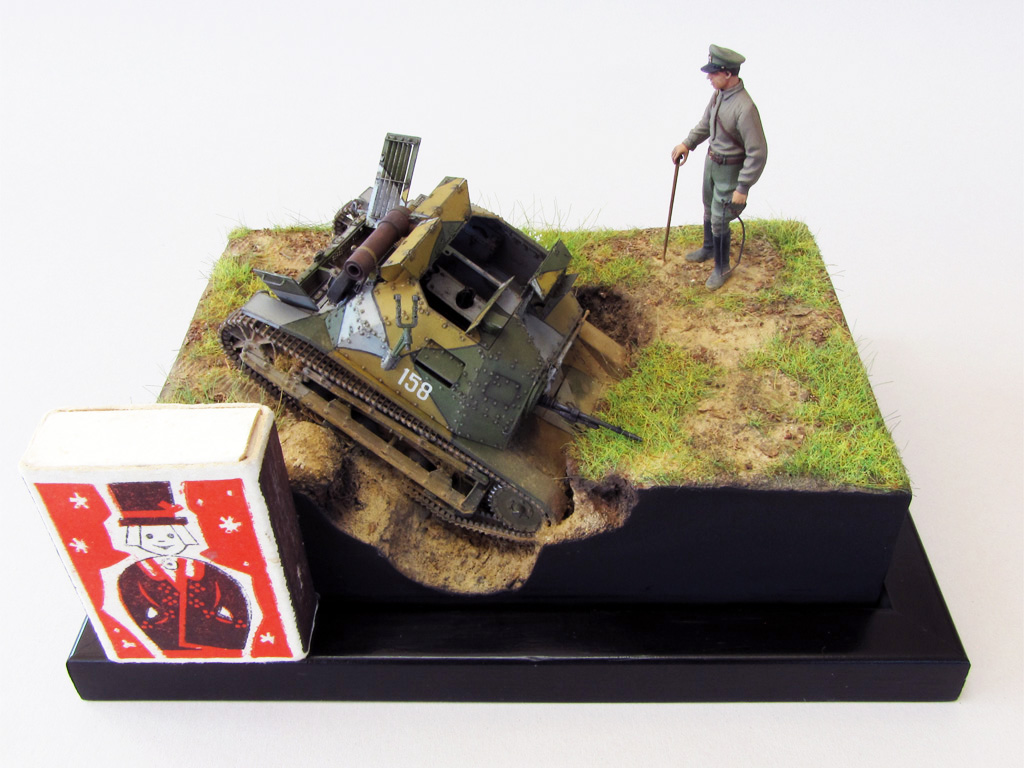
On November 6, 1934, Estonia ordered six TKS tankettes from Poland, together with two trailers and spare parts. The tankettes arrived in Estonia at the beginning of 1935, painted in an early Polish camouflage scheme consisting of irregular sand-yellow, olive-green and light-grey patches separated by thin black lines. They were assigned to the 3rd Company of the Auto-Tank Regiment. The vehicles were not repainted during their Estonian service, but at some point were given the numbers 153, 154, 156, 158, 164 and 165. These were applied in white to the sides of the upper hull as well as to the front and rear.
Following Estonia’s annexation by the Soviet Union in the summer of 1940, the Auto-Tank Regiment was disbanded and the tankettes were taken into Red Army service. Unfortunately, no information is available about their subsequent fate.
The model depicts tankette number 158 during exercises at Kurtna on June 28, 1939.
+ RPM 35005 TKS
+ Hornet HBH10, 5 heads wearing British style Officer's caps


No comments:
Post a Comment