The British Mark V was a heavy tank produced during the First World War. A direct development of the Mark I, the first tank to be used successfully in combat, its origins go back to the very beginning of tank warfare. The Mark V was produced from 1917 to 1918 in three configurations: the gun-armed Male, the machine-gun-armed Female and the Composite or Hermaphrodite, which combined both types of armament. The Mark V was later developed into the Mark V* and Mark V**, both of which had lengthened hulls.
Mark V tanks reached Estonia through General Nikolai Yudenich’s Northwestern Army. When the army retreated to the western bank of the Narva River, six tanks were handed over to the Estonian and Latvian armed forces. The first Estonian tank crews completed their training at the beginning of 1920, but the Mark V tanks saw no action under the Estonian flag during the War of Independence.
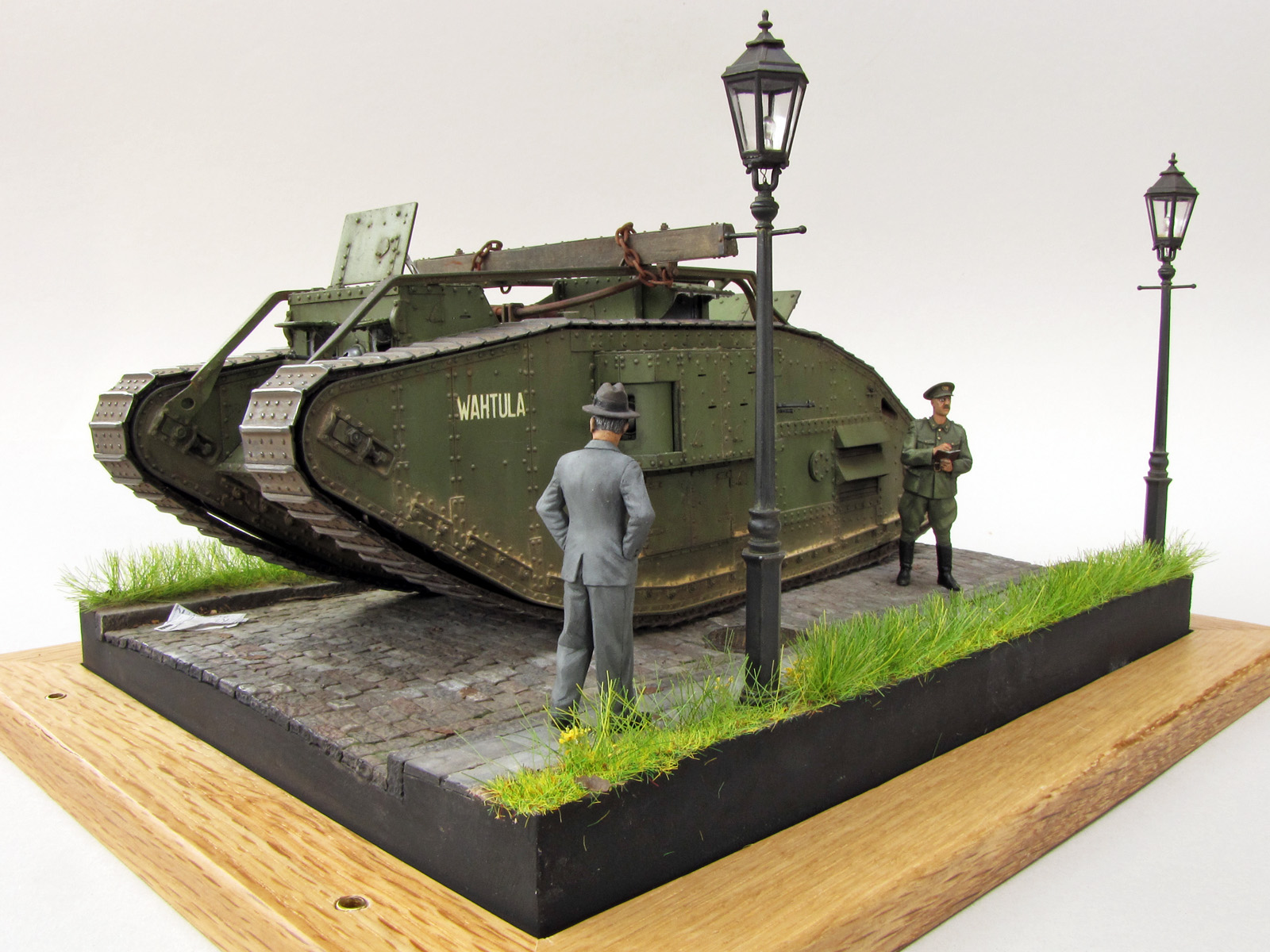
Wahtula was a Composite Mark V, with a machine-gun sponson on the left and a gun sponson on the right. Its original number in British service was 9349. In the Northwestern Army, it was named Бурый медведь. After entering Estonian service, it was renamed Wahtula. Its armament consisted of a Hotchkiss 6-pounder gun and five .303-inch Hotchkiss machine guns. The tank was powered by a 19-litre Ricardo six-cylinder petrol engine producing 150 hp. With a weight of 28.5 tonnes, however, it could reach a top speed of only 7.5 km/h.
The model depicts Wahtula in service with the Estonian Auto-Tank Regiment in the late 1920s or early 1930s. The scene could represent a rest stop during the tank’s return to its base after manoeuvres.
+ 1:35 Meng Model TS-029, British Heavy Tank Mk.V Female
+ 3X Aber R-21 Pyrene Fire Extinguishers Used in British Army
+ WWI British tank Mark V Mk.V Bolts & Nuts for Idlers 1/35
+ Miniart 35560 Street Lamps & Clocks
+ Miniart 35086 German Civilians
+ Miniart 35041 German Soldiers w/Fuel Drums
+ Hornet HBH10, 5 heads wearing British style Officer's caps




No comments:
Post a Comment